
Blog
Speciering Explained: Powerful Guide to How New Species Form

What Is Speciering?
Speciering is the natural process by which new species form over time through evolution, genetic changes, and adaptation to different environments. It happens when populations slowly become different and can no longer breed together. Speciering is the natural evolutionary process through which one species gradually splits into two or more distinct species due to genetic changes, environmental pressure, and reproductive isolation.
Introduction
Speciering has become a widely searched topic in 2026 because people are more curious than ever about how life on Earth is changing. Many readers are confused between the terms “speciering” and “speciation,” but both point to the same powerful idea: the formation of new species through evolution. As climate change, habitat loss, and environmental shifts continue to impact the planet, understanding how species adapt and evolve is no longer just for scientists—it matters to everyone.
The truth is simple and fascinating: evolution is still happening today. Animals, plants, and even tiny microbes are constantly changing to survive new challenges. Some species are adapting, some are disappearing, and some are slowly becoming entirely new species. This ongoing process shapes biodiversity and keeps ecosystems balanced.
Speciering also helps us understand how life responds to pressure, whether it is rising temperatures, new predators, or changing food sources. It connects directly to conservation, survival, and the future of our planet. In this guide, we will explore the meaning, process, types, examples, and importance of speciering.
Understanding the Meaning of Species and Speciering
To understand speciation, we first need to understand what a species is. In simple terms, a species is a group of living organisms that can breed with each other and produce fertile offspring. For example, dogs can breed with dogs, and humans can reproduce with humans, but different species usually cannot successfully reproduce together.
However, defining a species is not always as simple as it sounds. In nature, there are many exceptions. Some organisms may look very different but still belong to the same species, while others may look similar but cannot breed. This makes the concept of species more complex than it first appears.
Speciering is directly connected to this idea. It explains how one group of organisms slowly changes and eventually becomes different enough to be considered a new species. Over time, differences in genetics, behavior, and environment create clear separation.
The biological definition focuses on reproduction, meaning species are groups that can interbreed. But in real life, scientists also consider physical traits, DNA differences, and ecological roles. Genetics and reproduction play a major role because even small changes in DNA can lead to big differences over many generations.
How Speciering Works in Nature (Step-by-Step Process)
Speciering does not happen suddenly. It is a slow and natural process that takes many generations. It usually begins with variation within a population. No two individuals are exactly the same. Some may be stronger, faster, or better adapted to their environment.
Then, something causes separation. This could be a river, a mountain, climate change, or even a behavior change. Once separated, the groups stop sharing genes as much as before. This is the starting point of divergence.
As time passes, environmental pressure begins to shape each group differently. One group may live in a colder area, while the other may live in a warmer region. These conditions influence which traits are helpful for survival.
Natural selection strengthens these differences. Traits that help survival become more common, while less useful traits disappear. Over many generations, the two groups became more and more different.
Eventually, reproductive isolation forms. This means the groups can no longer breed successfully, even if they meet again. At this point, a new species has formed. This entire journey shows how life changes and adapts step by step.
The Role of Genetic Variation and Mutation
Genetic variation is the foundation of speciering. It means that individuals within a population have different genes. These differences may seem small, but they are very important for evolution.
Mutations are changes in DNA that create new traits. Some mutations are harmful, some have no effect, and some are helpful. When a helpful mutation appears, it can improve survival and be passed on to future generations.
Variation also comes from reproduction. When organisms reproduce, genes mix in new ways, creating diversity. This diversity allows populations to adapt to changing environments.
Over time, these small differences build up. A population that once looked similar may slowly become very different. Adaptation happens when useful traits become common in a group.
This process shows how tiny genetic changes can lead to big differences over time. Without variation and mutation, speciation would not be possible, because there would be no new traits to evolve.
Natural Selection and Environmental Pressure
Natural selection is one of the most important forces behind speciering. It simply means that organisms with helpful traits are more likely to survive and reproduce. These traits are then passed on to the next generation.
The idea of “survival of the fittest” does not mean the strongest always win. It means the best adapted organisms survive in a specific environment. For example, in a cold climate, animals with thick fur may survive better than those without it.
Environmental pressure plays a big role in this process. Factors like temperature, food availability, predators, and disease all influence which traits are useful. When conditions change, organisms must adapt or struggle to survive.
Over time, these pressures shape populations. The changes may be slow, but they are powerful. Natural selection ensures that each group becomes better suited to its environment, leading to long-term evolution and eventually new species.
Why Reproductive Isolation Is the Key to Speciering
Reproductive isolation is the final step that turns two populations into separate species. It means that the groups can no longer breed successfully with each other. Without this barrier, they would continue to mix and remain one species.
This isolation can happen in many ways. Geographic isolation occurs when physical barriers like mountains or rivers separate populations. Behavioral isolation happens when groups develop different mating habits or signals.
Timing differences can also create separation. Some species may breed at different times of the year or even different times of the day. This prevents them from mating.
Genetic incompatibility is another factor. Even if two groups try to reproduce, their offspring may not survive or may be unable to reproduce themselves. This ensures the groups remain separate.
Reproductive isolation is important because it locks in the differences that have developed over time. Once this happens, the formation of a new species is complete.
Main Types of Speciering Explained Simply
Speciering can happen in different ways depending on how populations are separated. One of the most common types is allopatric speciation, where groups are divided by geography. This could be an island, river, or mountain range that prevents them from interacting.
Sympatric speciering happens in the same location without physical separation. Instead, differences in behavior, food choice, or mating preferences cause groups to separate.
Parapatric speciering occurs when populations live next to each other but experience different environmental conditions. Even though they are close, they slowly become different due to limited interaction.
Peripatric speciering is similar to allopatric, but it involves a small group breaking away from a larger population. This small group evolves quickly because of its limited genetic diversity.
Each type shows that speciering is flexible and can happen in many different ways depending on the situation.
Real-Life Examples of Speciering in Nature
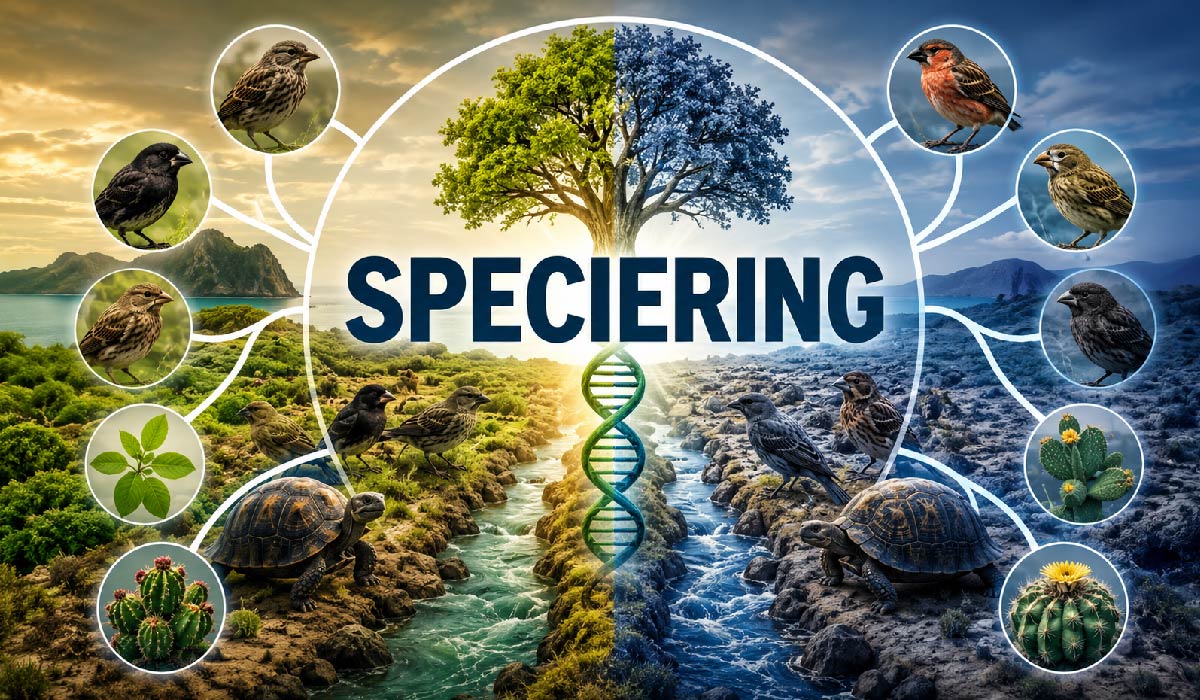
Nature provides many clear examples of speciering. One of the most famous is Darwin’s finches on the Galápagos Islands. These birds evolved different beak shapes to adapt to different food sources. This process is known as adaptive radiation.
African cichlid fish are another example. In isolated lakes, they have evolved into hundreds of different species, each with unique traits and behaviors. This shows how quickly speciering can happen under the right conditions.
Apple maggot flies provide a modern example. Some populations began feeding on apples instead of their original food source. Over time, this change led to separation and the formation of new groups.
Plants also show speciering through relationships with pollinators. Different flower shapes attract different pollinators, which leads to separation over time.
These examples prove that speciering is not just a theory. It is a real and ongoing process happening in the natural world.
Speciering and Biodiversity – Why It Matters
Speciering is the main reason Earth has such a wide variety of life. It creates biodiversity, which refers to the number of different species in an ecosystem. Without speciering, life would remain simple and limited.
Biodiversity is important because it supports ecosystems. Different species perform different roles, such as pollination, decomposition, and food production. These roles keep ecosystems balanced and functioning.
A diverse ecosystem is also more stable. If one species disappears, others can take its place. This resilience helps ecosystems survive changes and challenges.
Humans also depend on biodiversity for food, medicine, and resources. Protecting species means protecting the systems that support life on Earth.
Speciering in Different Fields Beyond Biology
Speciering is not limited to biology. In chemistry, chemical speciation refers to how elements exist in different forms depending on their environment. This is important for understanding pollution and reactions.
In environmental science, speciering helps explain how pollutants change and affect ecosystems. Different forms of a substance can have different impacts on living organisms.
In technology, speciering can be compared to system evolution. Software and tools change over time, adapting to new needs and environments.
In marketing, the idea is similar to niche specialization. Brands divide their audience into smaller groups and create specific products for each group. This shows how the concept of speciering can apply beyond nature.
Human Impact on Speciering
Human activity has a strong impact on speciering. Habitat destruction reduces the space where species can live and evolve. Climate change alters environments, forcing species to adapt quickly or face extinction.
Urbanization creates new environments where only certain species can survive. Some organisms adapt to cities, leading to new evolutionary paths.
Pollution also affects species by changing ecosystems and reducing biodiversity. In some cases, it can speed up evolution by creating new pressures.
Humans also influence evolution through artificial selection, such as breeding plants and animals for specific traits. This shows that speciering is not only natural but can also be influenced by human actions.
Conservation and the Future of Speciering
Protecting speciering means protecting the future of life on Earth. Conservation efforts focus on preserving habitats so species can continue to evolve naturally. Without safe environments, speciering cannot happen.
Maintaining genetic diversity is also important. A population with more genetic variation has a better chance of adapting to change.
Climate adaptation is another key area. As environments change, species need space and resources to adjust. Conservation helps ensure they have that opportunity.
Global efforts, including protected areas and restoration projects, play a major role. By supporting conservation, we protect not just current species but also future ones.
Common Myths About Speciering
Many people believe that new species appear suddenly, but this is not true. Speciesing is usually a slow process that takes many generations. Another myth is that evolution creates perfect organisms. In reality, it only creates organisms that are good enough to survive in their environment.
Some people think species are always easy to define, but this is not the case. Nature is complex, and boundaries are often unclear. Another common myth is that speciering has stopped, but it is still happening today all around us.
Understanding these myths helps us see the true nature of evolution and how life continues to change.
Why Studying Speciering Matters for Humans
Studying speciation helps us understand how life evolves and adapts. It gives us insight into how species may respond to climate change and environmental challenges. This knowledge is important for conservation and protecting biodiversity.
It also helps us understand the history of life on Earth. By studying how species formed in the past, we can better predict future changes.
Species explains why the world is full of different life forms. It connects science, nature, and human survival in a powerful way. Learning about it makes us more aware of our role in protecting the planet.
Conclusion
Speciering is one of the most important natural processes shaping life on Earth. It explains how species form, adapt, and survive in changing environments. Through genetic variation, natural selection, and reproductive isolation, new species continue to emerge over time.
This process is not just part of the past. It is happening right now in forests, oceans, and even cities. Understanding speciering helps us protect biodiversity and maintain the balance of ecosystems.
As humans continue to influence the planet, our responsibility grows. By supporting conservation and learning about evolution, we can help protect the future of life. Species show that life is always changing, adapting, and evolving, shaping the future of our planet every day.
(FAQs)
What is speciering in simple words?
Speciering means the process where one species slowly becomes two or more different species over time due to changes in genes and environment.
Is speciering the same as speciation?
Yes, speciation and speciation mean the same thing. Both describe how new species are formed through evolution.
How does speciering happen?
Speciering happens when a group of organisms becomes separated and changes over time until they can no longer breed with each other.
What causes speciering in nature?
Speciering is mainly caused by geographic separation, environmental changes, genetic mutation, and natural selection.
Can speciering still happen today?
Yes, speciering is still happening today. Animals, plants, and even bacteria are constantly evolving and forming new species.
Why is reproductive isolation important in speciation?
Reproductive isolation is important because it prevents two groups from breeding, allowing them to become completely separate species.
What is the best example of speciering?
A famous example is Darwin’s finches, which evolved different beaks on the Galápagos Islands based on their food sources.
How long does speciering take?
Speciering usually takes thousands or millions of years, but in some cases, it can happen faster in small or isolated populations.
Why is speciering important for biodiversity?
Speciering creates new species, which increases biodiversity and helps ecosystems stay strong and balanced.
Why do students need to learn about speciering?
Students should learn speciering to understand evolution, nature, and how living things change and survive over time.
Read Also: Tasyyblack Explained: Powerful Meaning, Identity & Future Trends

How Does HARDVOGUE Provide Customized Solutions for Label Materials?

SOKANY Small Appliance Brand Development Trends: A Guide for Distributors

How Smart Hydraulics Are Transforming Aviation Maintenance

Seasonal Digital Marketing: Making the Most of Ramadan and Key Shopping Periods

Seasonal Security: Preparing for Ramadan, Hajj Season, and Peak Periods in Saudi Arabia

How Effective Treasury Management Helps UAE Businesses Manage Cash Flow Risk

Polyimide Flexible PCB Fabrication: The Backbone of Lightweight and Durable Electronics

Communicating Across Cultures in a Diverse Workplace

Pyjamaspapper: Meaning, History and Cozy Lifestyle Guide

Meet Dorothy Bowles Ford: What Happened to Harold Ford Sr.’s Ex-Wife?

Who Is Jan Ashley? The Untold Story Of Robert Kardashian’s Ex-Wife

Who Is Charles Donald Fegert? Shocking Truth About Barbara Eden’s Ex-Husband

Josh Winterhalt: The Private Life of Sarah Wayne Callies’ Husband

Sharon Mobley Stow: The Private Life Behind Jim Acosta’s Ex-Wife

Who Is Harlene Rosen? The Untold Story Of Woody Allen’s Ex-Wife
